
Access Routes Built for Equipment and Weather
Road Building in Yacolt for private access, agricultural routes, and utility corridor development
Rural properties throughout Clark County require gravel roads that maintain surface integrity during wet months, support loaded equipment traffic, and provide reliable access to building sites, pastures, and utility infrastructure. Proper drainage and stable road construction prevent rutting and washouts on uneven terrain common across Southwest Washington acreage. RAM Landclearing Inc. builds gravel roads designed for residential driveways, farm equipment routes, and utility access paths where seasonal rain and soil conditions challenge road longevity.
Road construction begins with grading the roadbed to establish proper slope and drainage flow, followed by compacting the subgrade to create a stable foundation that prevents settling under load. Gravel is installed in layers with compaction between lifts, ensuring that the surface resists displacement when heavy vehicles turn or brake. On properties with clay-heavy soils or poor natural drainage, additional preparation may include shaping ditches or installing culverts to channel water away from the road surface.
Arrange a site evaluation to review terrain conditions, drainage patterns, and access requirements for your property.
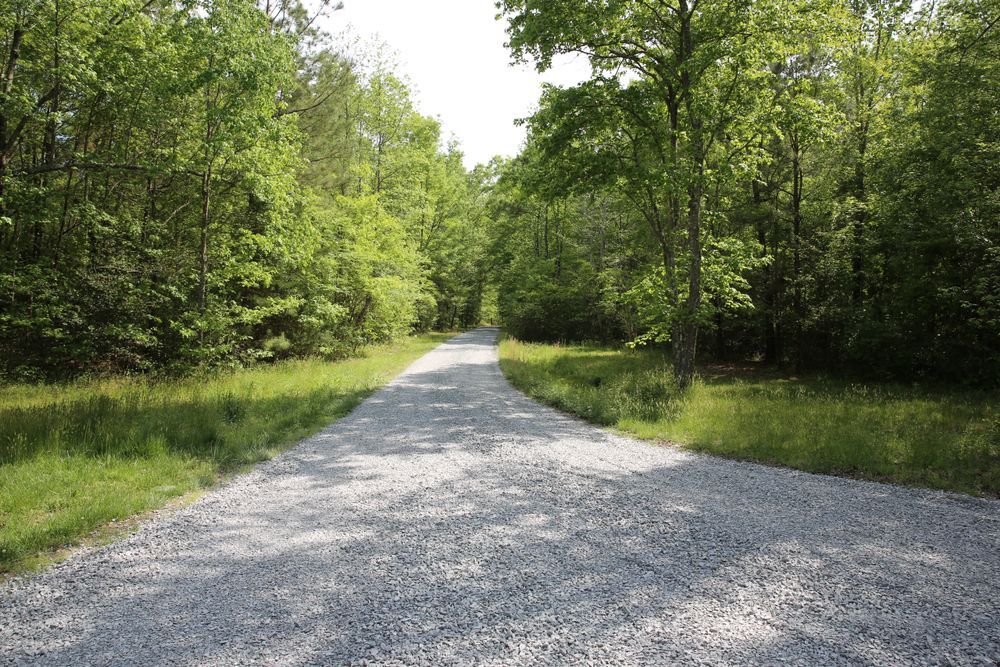
What Proper Road Preparation Requires
Building a gravel road that holds up to farm equipment, delivery trucks, and seasonal rain requires more than spreading rock over cleared ground. The roadbed must be shaped to direct water off the surface and into drainage features, the subgrade must be compacted to prevent soft spots that develop into ruts, and gravel must be sized and layered to resist migration under traffic. Projects throughout Yacolt and surrounding rural areas often involve balancing road width with clearing costs, determining optimal gravel depth based on expected traffic, and positioning drainage structures where water naturally concentrates.
Once the road is finished, you'll notice firm traction during wet weather, consistent surface height without depressions, and clear drainage that prevents standing water across the travel lane. Equipment no longer sinks into soft spots, delivery vehicles reach buildings without difficulty, and erosion stops carving channels across the roadbed. The road maintains these characteristics because the foundation was compacted and shaped rather than simply covered with gravel.
The service includes clearing vegetation from the roadbed corridor, grading to establish slope and drainage, and installing gravel to the depth required for your anticipated traffic. It does not include paving, asphalt overlay, or ongoing gravel replenishment, though the initial construction reduces the frequency of future maintenance by addressing drainage and compaction from the start.
Answers to Frequent Service Questions
Acreage developments and agricultural properties across the region require reliable access routes that function year-round without constant gravel replenishment or rut repair.
How deep does gravel need to be for a driveway that handles farm equipment?
Most agricultural access roads require six to eight inches of compacted gravel over a prepared subgrade, with additional depth in areas where heavy loads turn or where soil conditions are particularly soft, ensuring the road resists rutting during wet months.
What causes a gravel road to wash out during heavy rain?
Water flowing across the surface rather than off to the sides erodes gravel and carves channels, a problem prevented by crowning the roadbed so the center is slightly higher than the edges and by shaping ditches that intercept runoff before it gains velocity.
When should culverts be installed during road construction?
Culverts are necessary where the road crosses natural drainage channels, seasonal streams, or low points where water collects, preventing the road from acting as a dam that traps water and saturates the subgrade.
Can a gravel road be built on sloped terrain common in Clark County properties?
Roads on slopes require careful grading to balance acceptable grade percentages with drainage control, often incorporating cross-drains or water bars to prevent runoff from concentrating along the travel surface and eroding the roadbed.
What type of gravel works best for roads in Southwest Washington?
Crushed rock with angular edges and a range of particle sizes compacts tightly and resists displacement better than rounded river rock, with the specific size distribution depending on whether the road serves light residential traffic or heavy equipment.
RAM Landclearing Inc. coordinates grading, drainage preparation, and gravel installation from initial layout through final compaction. Request a site consultation to review your property's access challenges and develop a road plan suited to the terrain and intended use.